.webp)
.png)
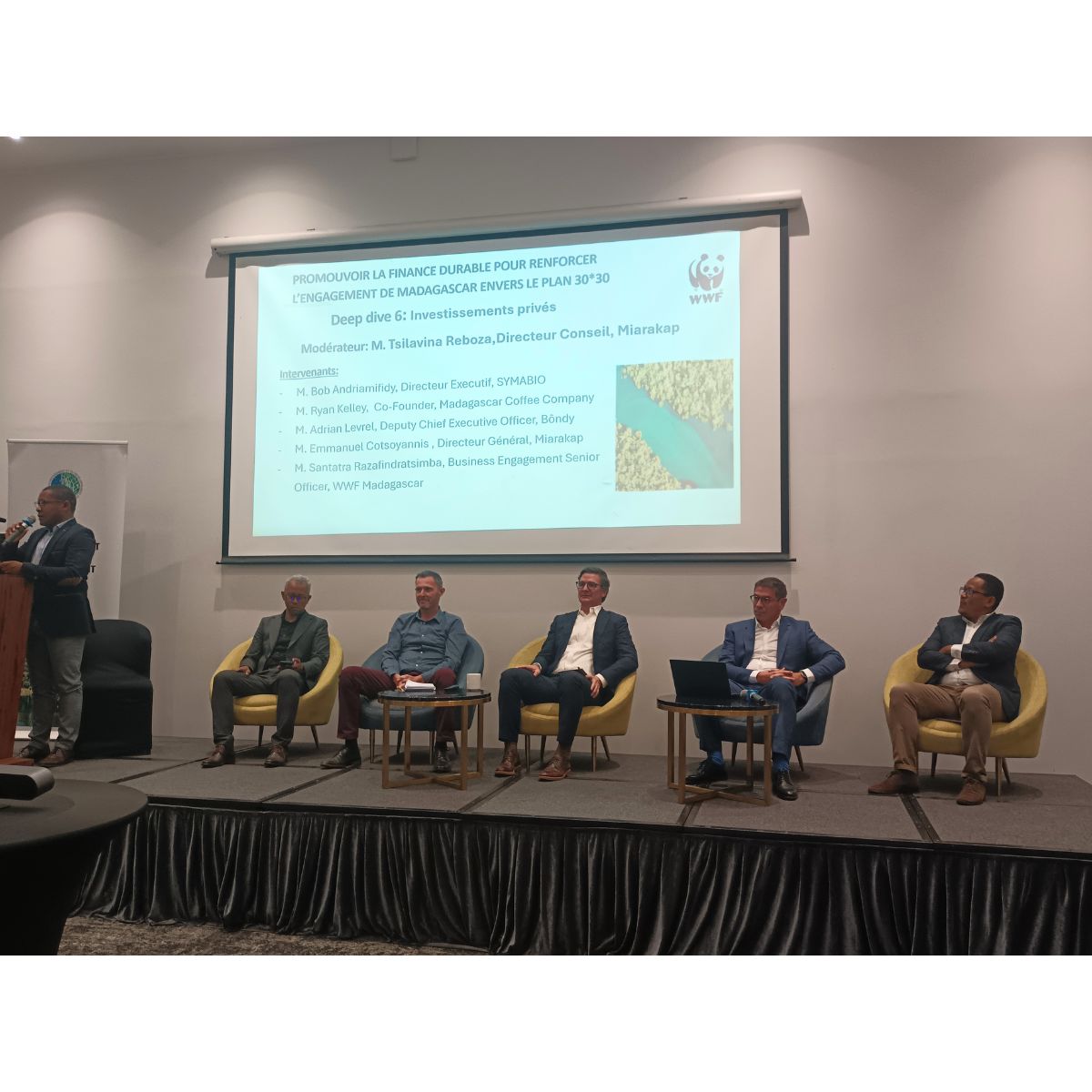

Madagascar must raise between $600 and $850 million by 2030 to fulfill its pledge to protect 30% of its territory. On April 28 and 29, the "Sustainable Finance for 30x30" workshop highlighted an often-overlooked reality: private capital can only act as a multiplier if it finds credible local operators to absorb it. Bôndy was cited as one of these operators. Here is why.
One workshop, two days, one shared question
Convened by WWF Madagascar and the Ministry of Environment and Sustainable Development, the workshop brought together key players in Malagasy conservation at the Radisson Blu: FAPBM, Tany Meva Foundation, Wildlife Conservation Society, Blue Heron Ventures, as well as the investment firm Miarakap and the Mitsiry fund. Two days were dedicated to a single question: How can the country finance the 30% of its territory it has committed to protecting, when available public funding remains far below what is needed?
Blended finance as a multiplier
The message from the panelists was threefold. First, blended finance acts as a multiplier: by providing guarantees or concessional capital, the public sector reduces the risk perceived by private investors, attracting them to areas they would not enter alone. The global scale of this, as documented by the think tank Convergence, has reached $273 billion mobilized to date.
Without operators, the mechanism remains empty
However, this mechanism remains empty without SMEs capable of absorbing the capital. In Madagascar, three models were cited as already operational: Madagascar Coffee Company, for shade-grown coffee; SYMABIO, for organic exports; and Bôndy, for agroforestry and ecosystem restoration. These are not pilot projects. They are companies that produce, pay communities, and report to auditors.
With $50 million in funding, the Mitsiry fund was presented as the missing link in the Malagasy financial ecosystem. It bridges the gap between incubation, seed funding, and larger-scale mechanisms like carbon funds and fiduciary vehicles. It does not claim to replace public funders; rather, it provides them with an entry point to deploy their capital with real leverage.
What Bôndy brings to this architecture
Our model was selected among the three cited for four reasons that we document quarter after quarter.
The agroforestry we implement does not seek to replace protected areas; it surrounds them. By creating stable income around conservation zones, it reduces the pressure on them—what theory calls an economic buffer zone, and what we call, more simply, having a way to make a living other than cutting down the forest.
Community compensation is not an extra; it is a parameter of our operational model. In Ambanja, the rice compensation received by our partner producers is indexed to the survival rate of their plants, measured at six and eighteen months. Only the trees that have survived determine what each family receives. In Bebaboky-Sud, the residents themselves decided how carbon benefit-sharing should be used, before any outside arbitration.
Our B Corp certification is not just a marketing badge. It anchors a requirement for auditable governance, which we extend quarter after quarter by publishing an impact report. The next one will be released before the end of the year, supported by a climate transition plan aligned with 2050.
Our plots are traceable down to the individual unit. Each planted hectare receives a unique identifier and a history locked on the Cardano blockchain, where any alteration can be detected during an audit. This level of granularity is what climate financiers demand today, just as they would for a profit and loss statement.
What is missing, and for whom
Three conditions external to the operators were reiterated at the closing. To financiers, Mitsiry asks to dedicate a portion of concessional capital to local funds, the rarest component of the system. To NGOs, the call is to help identify "conservation-friendly" SMEs. To the Malagasy government, two long-awaited actions are needed: securing land tenure and accelerating the implementation of Article 6 of the Paris Agreement, which conditions access to international carbon markets.
What is missing for the Malagasy 30x30 is therefore neither ambition nor financial mechanisms. These two levels already exist. What is missing is the number of local operators ready to receive capital, deploy it on the ground, and report on it plot by plot to an auditor. This capacity cannot be decreed at the end of a program; it is built during the months spent mapping without selling a thing.
Bôndy is open to discussions with funds, investors, and corporations interested in Madagascar's nature-positive economy. Let's connect.




.jpeg)

.png)

.jpeg)



.jpeg)


.jpeg)



.png)


.webp)